
IRN AР23488693. Supervisor: Kalashnikov P.A.
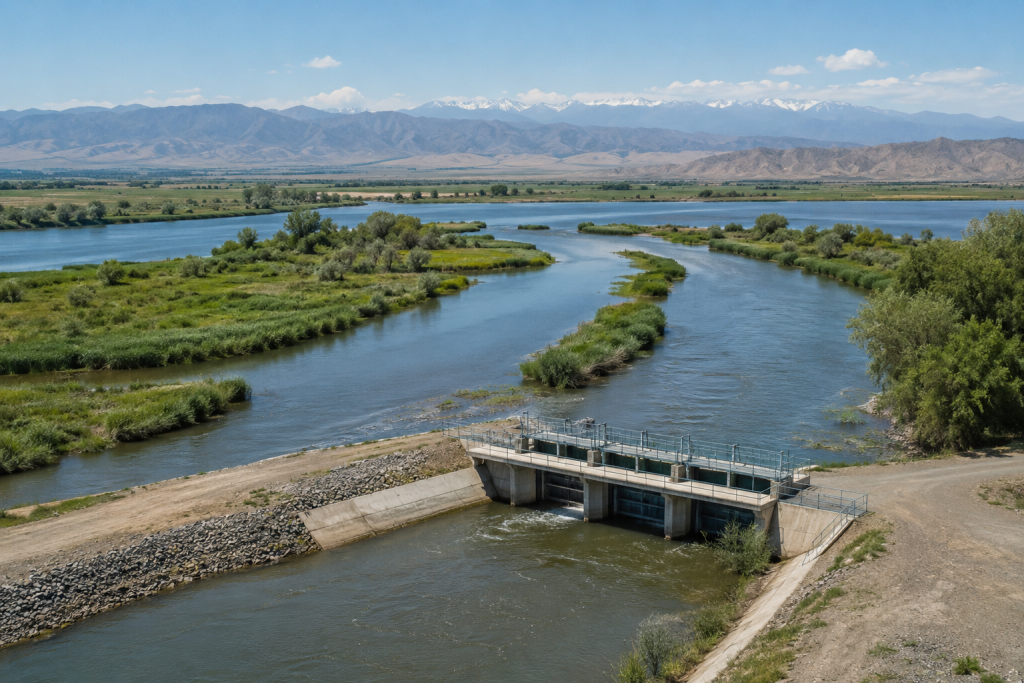
Report for 2025 under the budget program 217 “Development of Science” within the framework of grant financing of the SK MSHE RK AR23488693. “Scientific and methodological foundations of water supply for the lower reaches of the Shu River, Zhambyl region.”
The purpose of the program: To assess needs, develop recommendations and measures to improve the water supply of the lower reaches of the Shu River based on studies of the current state of agricultural and natural complexes of the river basin.
Direction of work: Ecology, environment and environmental management. Water resources
Application: Natural Sciences, Earth and Environmental Sciences. Earth Sciences
Program objectives:
– determination of the main parameters of water supply for the lower reaches of the Shu river;
– continuation of full-scale studies of the state of agricultural and natural complexes of the lower Shu river;
– development of water management measures for water supply of the lower reaches of the Shu River;
According to the calendar plan for the program for 2025, work programs and methods for conducting research for 2025 have been drawn up.
Results:
1 The main parameters of water supply of the lower reaches of the river, affecting the processes of functioning and development of agricultural and natural complexes, were determined. The water supply of the natural and economic complexes of the Shu river basin within the territory of Kazakhstan is constantly deteriorating, which is associated primarily with a general decrease in river flow, and only secondly with an increase in water consumption in the river basin. This requires the development and application of large-scale water management measures for the efficient use of water resources, which to some extent will contribute to the preservation and restoration of agricultural and natural complexes of the river basin. At the same time, the volume of water intake and use for the period 2011-2024 is relatively stable, and losses during water transportation are gradually growing. These data indicate, first of all, that the process of reducing the flow of the Shu River does not have a negative impact on the intake and use of water resources for the needs of the population and production of the region. Restrictions in water supply are reflected in the natural complex of the lower reaches of the river, the needs of which are taken into account according to the residual principle. And although the volume of water intake and use in the long-term average cross-section is about 10-32% of the total available water resources of the Shu River basin, it can be reduced by 20-30% due to the introduction of water-saving technologies and various measures for the rational use of water. The medium-term forecast of the situation with water supply in the lower reaches of the Shu River showed a 40% decrease in water supply by 2030 compared to 2011. The general trend towards a decrease in water supply in the lower reaches of the Shu River in the near future will lead to catastrophic consequences for the natural and economic complexes of this region, especially for territories on the border of Zhambyl and Turkestan regions.
2 The data of field studies of the current state of agricultural and natural complexes of the lower reaches of the river were supplemented and clarified, a preliminary assessment of the dynamics of changes in the state of agricultural and natural complexes was given. A characteristic feature of the intra-annual distribution of runoff in the mountainous part of the Shu River is its high natural regulation, due to increased underground supply and uneven distribution of flow rates in the lower reaches. At the same time, the flood summer wave forming in the mountainous part of the river basin. Shu is almost completely used for irrigation in the upper and middle reaches and therefore has absolutely no effect on the river regime below the village. Moyynkum. In spills, the entire mass of water is consumed for transpiration, evaporation and partially goes to replenish groundwater. Irrigation in the upper and middle valley has a significant impact on the distribution of runoff in the lower reaches. This is explained by the fact that the minimum costs fall for the summer due to the intake of water for irrigation, and the maximum ones increase due to the greatest pinching of return irrigation groundwater in winter and are superimposed on the spring flood. The state of agricultural and natural complexes of the lower reaches of the Shu River is associated with a constant decrease in the water resources of the river basin, as a result of: – global climate change with a negative impact on hydrological processes, creating irreversible changes in the distribution, size and quality of water resources; characterized by a change in the regime and a decrease in the volume of precipitation, an increase in the interannual variability of river flow, a change in water temperature, etc.; – anthropogenic impact on the river ecosystem, with high regulation of runoff, pollution of water resources, violation of the hydrological regime, irretrievable water consumption, etc. This process is characterized by the transformation of the river ecosystem: disruption of the living conditions of the flora and fauna of the river basin; modification of aquatic vegetation; reducing the biodiversity of water bodies; change of hydrological mode and deterioration of water quality.
3 Water management measures have been identified for the water supply of the lower reaches of the Shu River, which allow solving issues of managing agricultural and natural complexes, taking into account modern socio-economic, natural and climatic conditions. Water management measures for the water supply of the lower reaches of the transboundary Shu River include: a) Reducing the level of economic use of water and land resources in the Shu River basin, taking into account the natural and socio-economic capabilities of the territory, regulating the use of resources in accordance with the conditions for protecting the ecosystem of the river basin. b) Precise limitation of water intake by limiting the volume of water resources withdrawal from water sources, for rational use of water resources, control of losses and unproductive water discharges. c) Adaptation and implementation of modern technologies for irrigation of crops in the Shu river basin to increase productivity, reduce the volume of water resources used and minimize the negative impact on the environment. The implementation of these large-scale measures within the framework of the state plan will significantly reduce the shortage of water resources in the field of water supply to agriculture, but their impact on maintaining the natural complexes of the lower reaches of the Shu River is insignificant. In addition, due to the constant growth of water consumption in the sectors of the economy of the Zhambyl region and due to global climate change and transboundary water allocation, the decrease in surface runoff of the Shu River, the above measures do not fully solve the acute problems of water supply
List of published scientific papers:
Publications in peer-reviewed foreign or domestic publications recommended by KOKNVO
One (1) article has been published in a peer-reviewed domestic publication recommended by KOKSNVO, in the journal Hydrometeorology and Ecology, a special issue dedicated to the 90th anniversary of Saken Kalamkalievich Davletgaliev. Issue № 4 (119). 2025
Ibraev T.T., Li M.A., Bakbergenov N.N., Imanaliev TK, Balgabaev N.N. The current state of water supply for agricultural and natural complexes of the lower reaches of the Shu River/Hydrometeorology and Ecology No. 4 (119), 2025. FROM 22-35. https://doi.org/10.54668/2789-6323-2025-119-4-22-34
All works in accordance with the survey schedule have been completed in full.
Brief information for 2025 was presented in accordance with GOST 7.32-2017 and was registered with the National Center for State Scientific and Technical Expertise JSC. Registration number of brief information No. 0325РК01244.